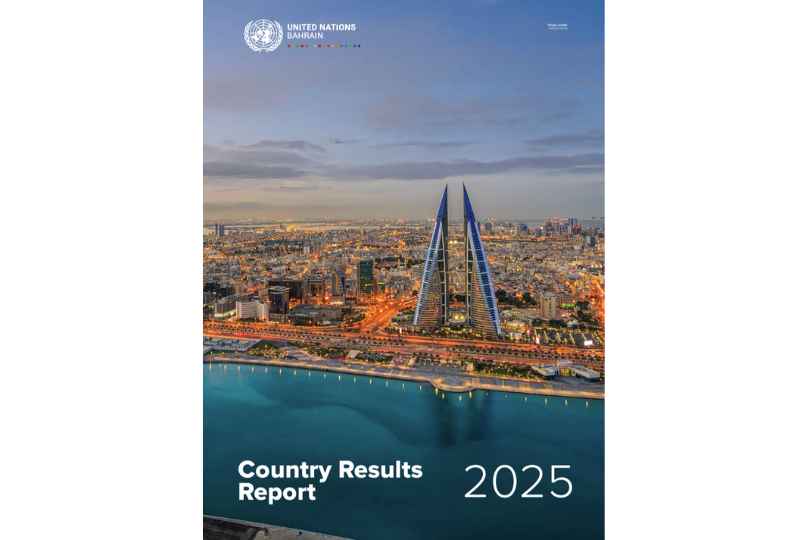
A new United Nations (UN) report shows Bahrain’s progress and commitment in tackling priority challenges, from environmental sustainability and healthcare to decent work and gender equality. This full assessment notes Bahrain's advancements and dedication to addressing key challenges, spanning environmental sustainability, healthcare, decent work, and gender equality. The 2025 Country Results Report details collective achievements by the UN Country Team (UNCT), which includes 22 agencies, and outlines steps taken by Bahrain to fulfill the 2030 Agenda for the Sustainable Development Goals (SDGs). This period marked the first full year of implementation for the Sustainable Development Co-operation Framework between Bahrain and the UN, signed in 2024. The framework represents a significant step in formalizing and guiding the collaborative efforts between Bahrain and the UN system.
The report notes, "Throughout 2025, Bahrain continued to advance the goals of its Economic Vision 2030." It specifies these goals encompass a more diversified economy, stronger social equity and public services, and deeper partnerships in regional and global affairs. Non-oil sectors, particularly financial services, information and communications, and logistics, drove economic growth. This diversification strategy is central to the nation's long-term economic stability and prosperity. The report identified youth unemployment, the full integration of women into the private-sector workforce, diversifying government revenue from hydrocarbon dependency, and ensuring fiscal sustainability as ongoing priority challenges. These areas remain focal points for continued policy development and implementation. According to the report, "These achievements reflect Bahrain’s active diplomacy and its commitment to international peace and security." This commitment is further evidenced by Bahrain's increasing engagement on the global stage.
Framework and Funding Details
The cooperative framework spans the period from 2025 to 2029, concentrating on four strategic areas identified as People, Prosperity, Peace, and the Planet. These pillars guide the joint initiatives and programmes undertaken by the UNCT and the Bahraini government, ensuring a holistic approach to sustainable development. For the UN Country Team's programmes, the budget requirement exceeded $13.8 million, reflecting the ambitious scope of the planned interventions. Approximately $6 million was ultimately spent on these vital programmes, demonstrating a significant investment in the country's development trajectory.
Bahrain's government contributed around $1.2 million towards these initiatives, showcasing its strong partnership and financial commitment to the SDGs. Contributions from the private sector provided over $950,000 in aid for the programs, noting the growing involvement of non-state actors in national development efforts. United Nations core funding allocated to these efforts surpassed $2.1 million, providing a key baseline for operational and programmatic activities. The primary goals for which funds were utilized included Decent Jobs and Economic Growth (SDG-8), reflecting efforts to foster inclusive economic opportunities; Climate Action (SDG-13), showing the urgency of addressing environmental challenges; and Good Health and Well Being (SDG-3), emphasizing improvements in public health outcomes. These targeted investments aim to create tangible improvements in key sectors across the country.
Key Development Achievements
Two governorates, Muharraq and Southern Governorate, achieved Healthy Cities status last year, as reported by the United Nations. This recognition signifies their success in creating environments that promote health and well-being for their residents. Additionally, two universities received designation as Health-Promoting Universities, elevating the total number of such institutions to eight. This expansion of health-focused educational environments plays a key role in fostering a culture of health among the youth and future workforce.
In efforts to support vulnerable populations, 95 individuals underwent training in suicide intervention techniques, specifically aimed at assisting migrant workers. This initiative addresses a critical mental health need within a particularly vulnerable demographic. Further initiatives included orientation programmes conducted for 296 household employers and 42 domestic workers, designed to improve working conditions and relationships within the domestic labor sector. These programmes contribute to upholding labor rights and promoting fair employment practices.
In the education sector, 781 students from 79 schools participated in two editions of the schools' Olympiad. These participants submitted a total of 164 projects as part of the competition, fostering innovation and critical thinking among young learners. Significant progress was also noted in environmental protection, with Bahrain phasing out 41.09 Ozone-Depleting Potential (ODP) tonnes of Hydrochlorofluorocarbons (HCFCs). This action successfully met the country’s 2025 target under the Montreal Protocol, demonstrating a strong commitment to international environmental agreements and global climate action.
A public awareness campaign focused on water conservation and reuse reached nearly one million people across the nation. This extensive outreach effort aimed to educate the public on sustainable water management practices. Survey results indicated that 80-85 per cent of respondents found the messages regarding water conservation and reuse to be influential, suggesting a high level of engagement and understanding among the population. 65 per cent of respondents expressed a willingness to adopt water-saving practices in their daily lives, indicating a positive shift in public attitudes and potential for behavioral change.
Urban environmental efforts included the creation of a Handbook on Urban Trees and Shrubs. This resource provides essential guidance for enhancing green spaces within urban areas. Following its development, municipal personnel received specialized training in urban forestry, equipping them with the knowledge and skills to effectively manage and expand the country's urban tree canopy. Addressing social issues, a Bahraini specialist participated in a Regional Training of Trainers on Technology-facilitated gender-based violence (TFGBV) held in Cairo. This participation shows Bahrain's commitment to addressing emerging forms of gender-based violence and building local capacity to combat them.
Broader Context and Challenges
Bahrain was elected as a non-permanent member of the UN Security Council for the 2026-2027 term, marking a significant achievement in its diplomatic engagement and influence on global peace and security matters. Last year, Bahrain also assumed the chairmanship of the GCC Supreme Council, further solidifying its leadership role within the Gulf Cooperation Council. The UN report stated, "Throughout 2025, Bahrain continued to advance the goals of its Economic Vision 2030. These include a more diversified economy, stronger social equity and public services, and deeper partnerships in regional and global affairs. Non-oil sectors drove growth, with strong performance in financial services, information and communications, and logistics. Youth unemployment and the full integration of women into the private-sector workforce remained priority challenges, as did the work of diversifying government revenue away from hydrocarbon dependency and ensuring fiscal sustainability." The report also noted, "These achievements reflect Bahrain’s active diplomacy and its commitment to international peace and security."
A five-year programme focusing on women in technology provided support to more than 50 women-led startups. This initiative aims to empower women entrepreneurs and foster innovation within the technology sector. This initiative distributed over $305,000 in prize funding across 19 ventures, providing key capital for these nascent businesses to grow and scale. In disaster preparedness, multi-hazard early warning systems (MHEWS) extended coverage to 90 per cent of the population. This expansion significantly enhances the country's ability to alert citizens to potential natural and man-made hazards, thereby reducing risks and improving response times. Bahrain also contributed to the launch of the first State of the Climate Report for the Arab Region, enhancing regional understanding of climate trends and informing future climate action strategies.
The UN report acknowledged that regional conflicts pose a challenge that could affect development efforts. These external factors can disrupt progress and divert resources, making sustained development more complex. In response to these potential impacts, the United Nations collaborated with the government to ensure operational continuity and to protect both personnel and programmes serving vulnerable populations. This proactive approach shows the commitment to humanitarian principles and the resilience of joint development efforts even in challenging geopolitical landscapes.