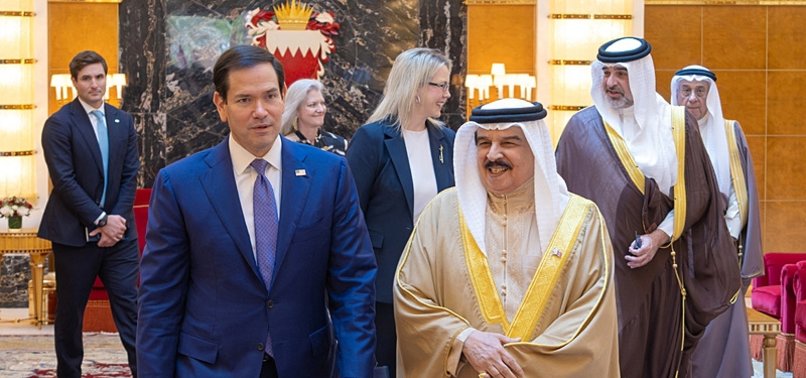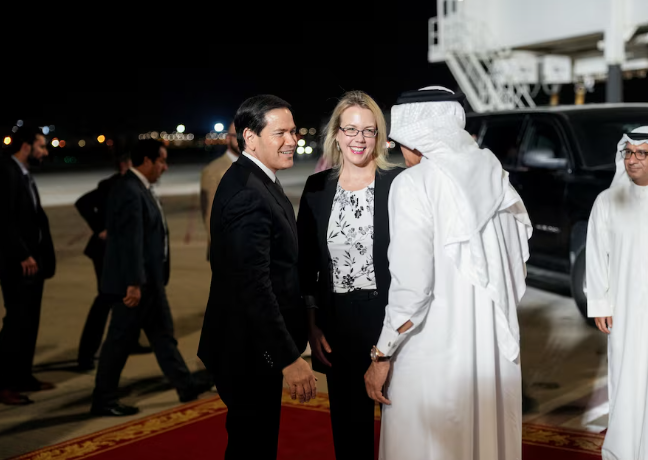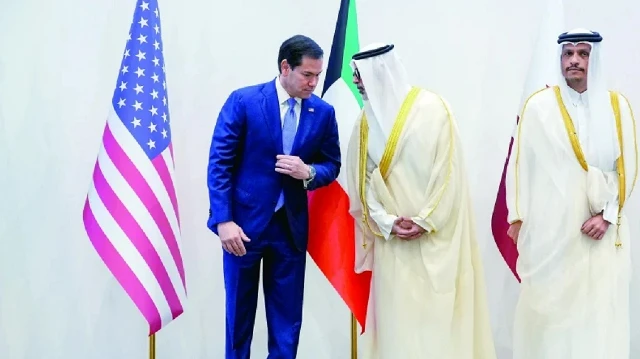
The United States and Gulf states convened a foreign minister-level summit in Bahrain following a recent war, where they adopted a joint stance against imposing transit fees in the Strait of Hormuz. U.S. Secretary of State Marco Rubio attended the meeting alongside foreign ministers from Qatar, Saudi Arabia, Bahrain, the United Arab Emirates (UAE), the Sultanate of Oman, and Kuwait. Mr. Rubio stated that the US administration seeks to establish peaceful relations with Iran in the post-war period and will pursue a policy of outreach in the region. The summit, held at the foreign minister level, brought together key regional players and the United States to address pressing issues of maritime security and regional stability. The joint stance adopted by the summit participants showed a collective commitment to maintaining unimpeded passage through the vital waterway.
Secretary Rubio emphasized that the agreement reached with Iran safeguards the interests of Gulf states. He said, "The interests of Gulf nations will be a priority in any decisions made during post-agreement negotiations." Mr. Rubio added, "If Iran abandons the export of its ideology and focuses solely on the well-being of its own people, we are ready to assist Iran." This statement from the U.S. Secretary of State noted the United States' commitment to ensuring that any diplomatic resolutions or agreements with Iran would not compromise the security or economic stability of its Gulf allies. The policy of outreach articulated by Mr. Rubio signals a strategic shift towards de-escalation and engagement in the region following the recent conflict. The US administration's desire to foster peaceful relations with Iran in the post-war period is central to this approach, aiming to build a more stable regional environment.
Regional Consensus on Transit
The United States, Qatar, and the Sultanate of Oman collectively reaffirmed their opposition to the implementation of transit fees within the Strait of Hormuz. This stance aligns with broader regional concerns regarding maritime passage through the strategic waterway. The Strait of Hormuz is a critical chokepoint for global energy supplies, and any disruption or additional costs imposed on shipping could have significant international economic implications. The reaffirmation of this position by these three nations signals a strong united front against any measures that could impede the free flow of goods and energy through the Strait. Their collective assertion shows the shared belief that the Strait of Hormuz must remain open and accessible without additional financial burdens.
Meanwhile, Iran articulated its position on any proposed framework for regional stability, asserting that a credible arrangement must be rooted in direct coordination with Iran. This coordination, according to Iran, should specifically operate under the provisions of Article 5 of the Islamabad memorandum. Iran's insistence on this particular article suggests a desire for formal recognition of its role in regional security discussions and mechanisms governing the Strait. The Islamabad memorandum, a document related to regional cooperation, appears to be a key reference point for Iran in defining its terms for engagement on maritime transit issues. Iran's emphasis on direct coordination notes its view that no significant decisions regarding the Strait's security or operational framework can be made effectively without its explicit involvement and consent. This position reflects a broader demand from Tehran for its central role in regional security architecture to be acknowledged and integrated into any future agreements.
Oman's Corridor Initiative
The Sultanate of Oman announced the opening of a temporary security corridor for passage through the Strait of Hormuz. This initiative aims to maintain unimpeded maritime transit through the critical waterway. The corridor is intended to offer a secure route for vessels, addressing concerns about stability and potential disruptions in the Strait. Oman's proactive measure is designed to provide a practical solution for safe navigation amidst ongoing geopolitical tensions and discussions surrounding transit fees. The establishment of such a corridor shows the urgent need to ensure the continuity of global trade and energy supplies that pass through this vital maritime artery.
Bahraini Foreign Minister Abdullatif bin Rashid Al Zayani expressed support for Oman's declaration regarding the temporary corridor. Speaking in Manama, Mr. Al Zayani indicated that Bahrain views the Omani initiative as a constructive step towards ensuring the continued free flow of international shipping. The Bahraini minister emphasized the importance of regional cooperation in safeguarding maritime security and trade, particularly given the Strait of Hormuz's role as a vital chokepoint for global energy supplies. The temporary corridor is seen as a practical measure to mitigate risks and sustain commercial activity in the region amid ongoing discussions about transit fees and broader security arrangements. The endorsement from Bahrain further solidifies regional support for practical solutions that prioritize maritime safety and economic stability. This collaborative approach among Gulf states notes a shared commitment to de-escalation and the maintenance of open sea lanes.
Iran's Stance and IRGC Warnings
Iran stated that safe passage through the Strait of Hormuz cannot be guaranteed under ambiguous arrangements or parallel routes without Tehran’s consent. The Iranian Revolutionary Guard Corps (IRGC) further declared that the only authorized transit route through the Strait of Hormuz is the one designated by Iran. According to the IRGC, all vessels must pass through designated routes exclusively in coordination with its navy. "A new route for vessels passing through the Strait of Hormuz has been announced by certain authorities," the Iranian Revolutionary Guard Corps (IRGC) said, adding, "This is unacceptable and extremely dangerous. Necessary measures will be taken against any vessels that violate this." The IRGC's firm declaration shows Iran's insistence on its sovereign control over the Strait's navigation, rejecting any alternative routes or frameworks not sanctioned by Tehran. This statement serves as a clear warning to international shipping, emphasizing that any non-compliance with Iran's designated routes would be met with consequences. The IRGC's position notes the complex and often contentious nature of maritime control in this strategically key waterway, directly challenging initiatives like the temporary security corridor proposed by Oman.
Meanwhile, the US Senate rejected a resolution to withdraw military forces deployed against Iran. The resolution, introduced by Democratic Senator Tim Kaine, failed to pass with a vote of 50 to 47. Senator Kaine's resolution sought to limit presidential authority regarding military action against Iran, reflecting ongoing debates within the US Congress about the scope of executive power in foreign policy and military engagements. The narrow margin of the vote, with 50 against and 47 in favor, indicates significant divisions within the Senate on the appropriate level of military presence and engagement in the region. The rejection of the resolution means that the existing deployment of US military forces against Iran remains unchanged, maintaining the current strategic posture in the Gulf.
Broader Geopolitical Context
Ship traffic through the Strait of Hormuz continued on Friday despite an attack on a container vessel. This incident shows the persistent security challenges in the region, even as diplomatic efforts are underway to stabilize maritime routes. The continued flow of traffic, despite the attack, reflects the critical importance of the Strait for global trade and the resilience of shipping operations in navigating complex security environments.
In other global transit news, the Panama Canal expects its fiscal 2026 revenue to exceed an initial $5.2 billion forecast. This optimistic financial outlook for the Panama Canal notes the strong demand for global maritime transit and the economic significance of such chokepoints. Traffic through the Panama Canal previously peaked at 41 ships daily, demonstrating its capacity and role in facilitating international commerce. The projected increase in revenue further emphasizes the growing global reliance on efficient and secure shipping lanes worldwide. Meanwhile, a US federal judge ordered the Justice Department to release additional unredacted Epstein files or justify its redactions by July 2. This unrelated development notes ongoing legal processes in the United States, providing a broader context of current events.