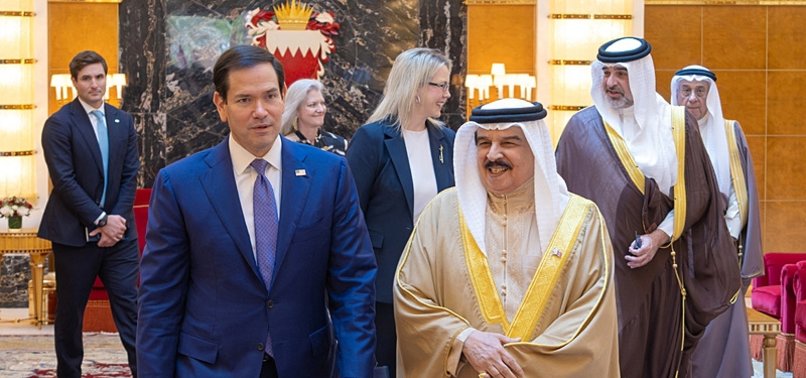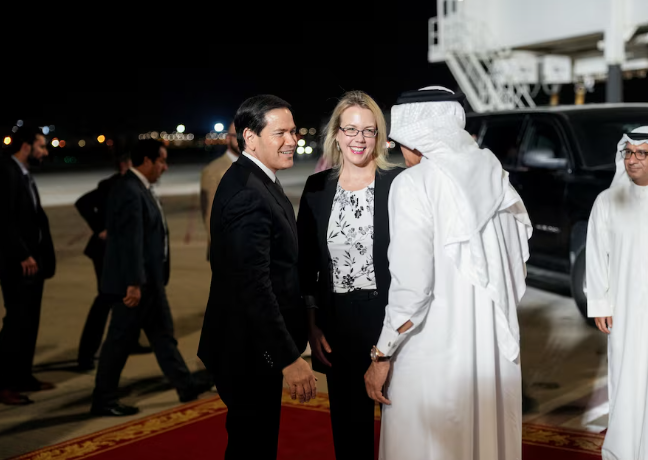
U.S. Secretary of State Marco Rubio will meet with Bahraini officials on Thursday during the final leg of his trip to the Middle East. Rubio arrived in Bahrain's capital, Manama, on Wednesday night. His three-day tour of the Gulf marks the first high-level diplomatic mission since the U.S.-Iran framework agreement was announced last week. The agreement aims to end the conflict between the two nations, making Rubio's visit a critical diplomatic effort following the breakthrough. The primary objective of Secretary Rubio's diplomatic push is to present the Trump administration's preliminary Iran accord to skeptical Gulf Arab allies and garner their understanding, if not explicit support, for the controversial agreement. This mission is particularly sensitive given the long-standing regional tensions and the Gulf states' apprehensions regarding Iranian influence.
Diplomatic Push in Manama
Manama, the capital of Bahrain, hosts the headquarters of the U.S. Navy's Fifth Fleet, showing its strategic importance to American interests in the region and its role in maintaining stability in vital waterways. During his visit, Marco Rubio is also scheduled to meet with the Gulf Cooperation Council (GCC). The GCC is an economic and political union comprising six Sunni monarchies, established to foster cooperation and integration among its member states. These nations include Saudi Arabia, Qatar, Oman, the United Arab Emirates, and Kuwait. The collective security and economic stability of these nations are closely intertwined with U.S. Foreign policy objectives in the Middle East. All six member states of the GCC are considered strategic allies of the United States, playing key roles in regional security initiatives and global energy markets. Rubio's meetings with these key allies are designed to address their concerns directly and provide assurances regarding the implications of the U.S.-Iran framework agreement. The discussions are expected to cover a wide range of security issues, economic cooperation, and the future of regional stability in light of the evolving diplomatic landscape.
Concerns Over Iran Accord
At previous stops in the United Arab Emirates and Kuwait, Marco Rubio sought to assure officials that the proposed deal was not overly favorable to Iran. These assurances were deemed necessary as many Gulf nations view any concessions to Tehran with deep suspicion, fearing an emboldened Iran could destabilize the region further. The Trump administration has maintained that the agreement includes significant concessions from Tehran, framing it as a necessary step towards de-escalation. U.S. President Donald Trump stated on Tuesday that "Iran had agreed to nuclear inspections into 'infinity'," suggesting a full and perpetual oversight mechanism that would prevent Iran from developing nuclear weapons. However, Tehran responded by saying it had made no such concession during the negotiations, creating a direct discrepancy between the two sides' public statements and raising questions about the true scope and limitations of the agreement. This divergence in reporting has fueled skepticism among Gulf allies, who remain wary of Iran's intentions and the enforceability of any future accord. The U.S. And Iran concluded their first round of negotiations in Switzerland on Monday, laying the groundwork for the framework agreement that is now the subject of intense diplomatic scrutiny.
The draft U.S.-Iran agreement has raised concerns among Gulf allies due to several key provisions. Notably, the agreement includes no limits on Iran's ballistic missiles, a point of contention for countries in the region that view Iran's missile program as a significant and growing threat to their security. The development and proliferation of these missiles by Iran have long been a source of anxiety for its neighbors. The draft agreement contains provisions that some observers believe could expand Tehran's regional influence. These provisions potentially allow Iran to exert greater control over critical oil shipping lanes, such as the Strait of Hormuz, which are vital for global energy markets and regional stability. Any perceived increase in Iran's leverage over these strategic chokepoints is a major concern for the Gulf states, whose economies are heavily reliant on oil exports. Gulf Arab nations have expressed apprehension about any arrangement that might embolden Iran or alter the regional balance of power, fearing it could lead to increased proxy conflicts or direct confrontations. Their long-standing rivalry with Iran, often characterized by sectarian tensions, makes them particularly sensitive to any shifts in regional dynamics.
Allies' Security Assurances
Marco Rubio has sought to present the Trump administration's preliminary Iran accord to skeptical Gulf Arab allies, aiming to alleviate their fears and demonstrate the U.S. Commitment to their security. This diplomatic push occurred as the U.S. And Iran concluded their first round of negotiations in Switzerland on Monday, signaling the seriousness of the diplomatic efforts to resolve the long-standing conflict. Bahrain, where Rubio is currently visiting, is ruled by a Sunni monarchy, despite having a Shi'ite majority. This demographic and political reality adds another layer of complexity to regional dynamics and the perception of Iranian influence, as Iran is predominantly Shi'ite. The draft U.S.-Iran agreement includes a proposed $300 billion reconstruction fund, intended to support post-conflict recovery efforts and stabilize the region. However, Rubio has stated that he would not be asking regional allies to contribute to any reconstruction fund during his current trip. This clarification aims to reassure Gulf states that the U.S. Is not seeking to burden them financially with the aftermath of a deal they view with apprehension, but rather to focus on addressing their immediate security concerns and the implications of the agreement. The U.S. Secretary of State’s visit is therefore critical for managing expectations and reinforcing alliances in a period of significant geopolitical change.