Following recent United States military actions, Iran's Revolutionary Guards announced they attacked a U.S. Military site in Jordan. The strikes occurred after U.S. Forces bombed targets in Iran's south and west. This escalation marks a significant increase in regional tensions, drawing a strong response from the United States. President Donald Trump warned of severe repercussions for Tehran, stating unequivocally, "Every time Iran kills an American Soldier they will pay for that killing many times over!" This forceful declaration showed the gravity of the situation from the U.S. Perspective. Meanwhile, a health ministry official in Iran reported that the recent U.S. Strikes on Iran resulted in 50 civilian deaths and 500 wounded, figures that further inflamed the already volatile situation and contributed to the escalating tensions in the region. The civilian casualties highlight the devastating human cost of the ongoing conflict and fuel calls for retaliation from Iranian factions.
US Strikes Iran's Coast and Cities
United States Central Command (USCENTCOM) stated it had targeted Iranian military command centers, maritime capabilities, missile and drone launch sites, and air defense systems. These full strikes were designed to degrade Iran's military infrastructure and its ability to project power. The strikes impacted multiple locations across Iran, demonstrating the broad scope of the U.S. Military operation. Specifically, the coastal cities of Konarak and Chabahar, both situated in Iran's southern region, were among the targets. These strategic coastal locations are vital for Iran's maritime operations and defense. The city of Khorramabad and a civilian site outside Abdanan, both situated in western Iran, also came under attack during the operations. The inclusion of targets in both the south and west indicates a wide-ranging assault on Iranian military assets. These actions mark a continuation of hostilities that began on February 28 with U.S.-Israeli attacks on Iran, setting a precedent for the current wave of retaliatory actions and counter-strikes.
The conflict has led to a significant increase in U.S. Casualties, with US troop deaths rising to 17 over the weekend, a stark reminder of the dangers faced by American personnel deployed in the region. Overall, the war has resulted in thousands of fatalities, with the majority of these deaths occurring in Iran and Lebanon, showing the widespread human cost of the protracted conflict. The mounting death toll on all sides paints a grim picture of the regional instability.
Iran's Retaliation Across the Gulf
In a series of coordinated retaliatory actions, Iran targeted United States sites in Bahrain, Kuwait, and Jordan on Tuesday, according to official reports from various sources. These strikes followed earlier incidents, including attacks on Kuwaiti power generation and water desalination plants on Monday, which resulted in several generation units being taken out of service, severely impacting critical infrastructure. The Iranian army confirmed its involvement in these recent operations, stating it launched drone attacks against three separate U.S. Military bases located in Kuwait on Tuesday. These drone assaults represent a significant escalation in Iran's direct engagement with U.S. Forces and assets in the Gulf.
Further actions by Tehran included claims from Iran's Revolutionary Guards that they had targeted infrastructure in Bahrain belonging to the U.S. Tech company Amazon. This specific targeting of a commercial entity suggests an intent to disrupt economic interests linked to the United States, adding another dimension to the nature of the conflict. In response to the aerial threats, Jordan's forces reported successfully intercepting and destroying five Iranian drones, demonstrating their defensive capabilities against the incoming attacks and preventing potential damage. The Guards also specifically claimed responsibility for attacking a U.S. Military site in Jordan, further noting the widespread nature of their retaliatory operations across multiple Gulf states.
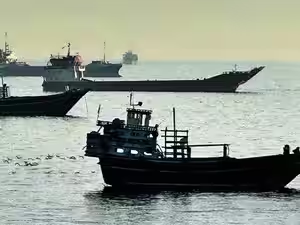
Maritime incidents also marked the escalation of hostilities, particularly in the critical Strait of Hormuz. The maritime security agency UKMTO reported on Tuesday that a tanker in the Strait of Hormuz had been struck by a projectile, raising immediate concerns about the safety of international shipping. Separately, Iran's Revolutionary Guards stated that two oil tankers caught fire after experiencing explosions while attempting to transit the southern route of the Strait. These incidents show the growing risks to global energy supplies and maritime trade traversing this vital waterway, which is a chokepoint for a significant portion of the world's oil.
Regional Tensions and Global Impact
The escalating cycle of attacks had immediate repercussions on global markets. Oil prices gained nearly 2% amid the rising tensions, reflecting market concerns over regional stability and the potential for disruptions to oil supplies from the Middle East. This price surge indicates the global economic sensitivity to conflicts in this strategically important region. The United States State Department, in response to the deteriorating security situation, issued a new "worldwide caution" for Americans, citing "heightened tensions in the Middle East" as the explicit reason for the advisory. This broad warning reflects Washington's assessment of the increased risks faced by its citizens abroad.
Maritime traffic in the Strait of Hormuz demonstrated an immediate and measurable impact, with only four commodity vessels crossing the strait on Monday, a significant decrease from seven the previous day. This reduction in traffic notes the direct effect of the perceived dangers on commercial shipping operations through the vital strait. Separately, a senior Iranian official told Reuters on Monday that Tehran had received a proposal from mediators for a 10-day ceasefire, suggesting potential diplomatic overtures amidst the intense conflict. This development, if pursued, could offer a glimmer of hope for de-escalation, even as military actions continue. The broader regional context includes parts of Lebanon remaining under Israeli occupation following attacks on Israel by Hezbollah fighters, illustrating the interconnected and multi-faceted nature of conflicts in the Middle East. This long-standing tension adds another layer of complexity to the already volatile situation.
Reactions and Diplomatic Front
The ongoing conflict continues to manifest through various incidents across the region. A tanker sustained a hit in the Strait of Hormuz on Tuesday, marking another incident in the critical shipping lane and reinforcing fears about maritime security. Elsewhere, explosions were reported around the city of Shiraz in southern Iran, indicating potential internal security incidents or further military actions impacting Iranian territory. These reports contribute to a sense of widespread insecurity across the country. Meanwhile, Yemen's Iran-aligned Houthis announced a naval blockade targeting Saudi Arabia on Monday, further complicating regional maritime security and adding another front to the broader regional power struggles. This blockade poses a direct threat to Saudi Arabian shipping and trade, potentially drawing more actors into the conflict.
In a significant diplomatic development amidst the escalating military actions, Lebanese President Joseph Aoun is scheduled to meet with President Donald Trump at the White House on Tuesday. This high-level meeting shows the international community's concern over the regional crisis and the potential role of diplomatic engagement in seeking solutions. The discussions between President Aoun and President Trump are expected to cover the ongoing tensions, the plight of Lebanon, and potential pathways to de-escalation, noting the complex interplay between military confrontation and diplomatic efforts in the Middle East. The meeting also signifies the United States' continued engagement in regional affairs, even as it faces direct military challenges from Iran and its allies.