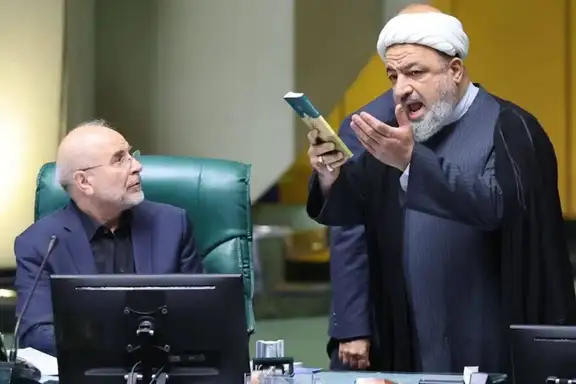
Hardline lawmaker Hamid Rasaei has accused Parliament Speaker Mohammad Bagher Ghalibaf of betraying Supreme Leader Ali Khamenei's call for revenge by signing a memorandum that Rasaei claims blocks retaliatory action against the United States. Rasaei stated that the agreement renders "Revenge is fundamentally incompatible with this memorandum." He further elaborated, "As you can see, Mr. Ghalibaf is tying himself in knots, scrambling to link revenge to the reappearance of the Imam of the Age, because he has signed something that prevents you from taking revenge." Rasaei warned, "Those who want revenge removed from the equation so that it never happens—what are they really after? They want this threat to continue hanging over your leader." He concluded, "This would become the prelude to a coup without a single shot being fired. There must be revenge. There absolutely must be. Revenge is…"
The Islamabad Accord
The Islamabad memorandum establishes an agreement between Iran and the United States, committing both nations to cease military operations. Under the terms of this accord, they are bound to refrain from initiating further attacks against each other. The memorandum also stipulates that both parties must avoid the threat or use of force in their interactions. This understanding aims to de-escalate tensions and prevent future direct military confrontations between the two countries. The specifics of the memorandum outline a framework for mutual restraint, focusing on a cessation of hostilities.
Lawmaker's Stark Accusations
Hardline lawmaker Hamid Rasaei warned that the alleged paralysis resulting from the Islamabad memorandum could lay the groundwork for a "coup without firing a shot." According to Rasaei, the agreement's terms undermine the nation's capacity to respond to perceived threats effectively. He asserted that such a situation would leave the country vulnerable to internal power shifts rather than external military action, creating an environment where a change in leadership could occur without direct conflict.
Rasaei further argued that abandoning immediate retaliation would allow threats against the new Supreme Leader Mojtaba Khamenei to remain in place, thereby preventing him from appearing publicly. He claimed that the lack of a decisive response to perceived aggressions would keep the leadership in a state of insecurity, forcing Mojtaba Khamenei to maintain a low profile. This, Rasaei suggested, would diminish the authority and visibility of the Supreme Leader, a critical figure in the nation's political and religious structure.
In his remarks, Rasaei contended that any threat should be treated as an attack, and Iran should strike before adversaries have an opportunity to carry them out. He emphasized a proactive approach to national security, stating that waiting for an actual attack to materialize would be a strategic error. Rasaei’s position shows a belief that preemptive action is necessary to deter potential adversaries and protect national interests, rather than waiting for hostilities to commence.
Differing Views on Retaliation
Parliament Speaker Mohammad Bagher Ghalibaf has stated that vengeance for the slain supreme leader would be achieved through the "liberation of Jerusalem," according to reports. Conversely, Mojtaba Khamenei described retaliation as a "national demand" that "will most certainly be carried out," indicating a different perspective on how to address the situation.
These varying viewpoints highlight an internal debate over the appropriate response. Fayyaz Zahed, an adviser to former foreign minister Mohammad Javad Zarif, suggested that Mojtaba Khamenei should "put his personal issues aside" and forgo revenge, implying a need for leadership to prioritize broader national interests over individual grievances. Adding to the discussion, former president Mohammad Khatami called for an "honorable peace," advocating for a diplomatic solution rather than continued confrontation.