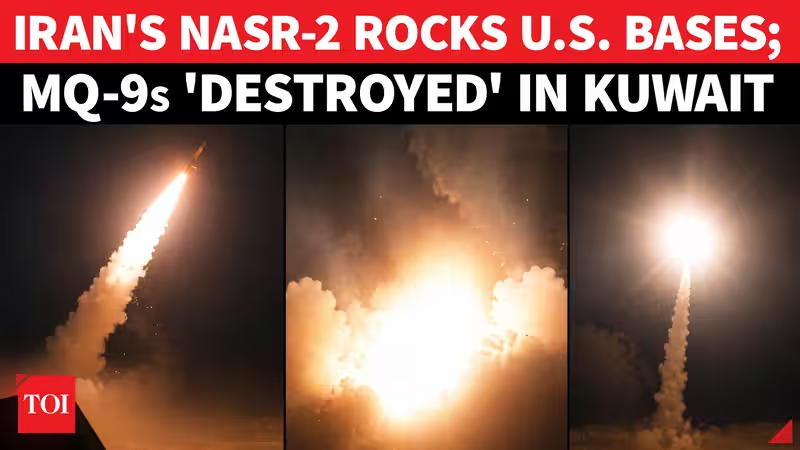
Iran's Islamic Revolutionary Guard Corps (IRGC) announced the launch of the third wave of Operation Nasr 2, claiming missile and drone strikes targeting United States bases in Bahrain and Kuwait. The IRGC's statement indicates a continuation of its operational activities, suggesting a sustained campaign against American military presence in the region. This development follows earlier phases of Operation Nasr, as detailed in previous reports, marking a notable progression in the IRGC's stated operational goals. The claimed attacks represent a significant escalation in regional tensions involving Iranian forces and US military assets, potentially raising concerns about broader stability. The specific timing and impact details of these alleged strikes were not immediately available, leaving key aspects of the incident unconfirmed.
Details of the Operation
The Islamic Revolutionary Guard Corps (IRGC) stated that the operation utilized a combination of advanced weaponry, including Shahed drones, Khaibar Shekan (Khaibar-Buster) missiles, and Zolfaghar ballistic missiles. These munitions were reportedly deployed as part of what the IRGC designated as the third wave of Operation Nasr 2. The specific types of drones and missiles mentioned, such as the Shahed drones known for their range and the Khaibar Shekan and Zolfaghar ballistic missiles recognized for their precision capabilities, indicate a varied and sophisticated approach to the alleged strikes. The IRGC's detailed description of the weaponry used aims to show the gravity and technical capacity behind their claims.
According to the IRGC's claims, the targets of these missile and drone attacks encompassed several key United States military assets. These included weapons depots, critical military infrastructure, and facilities specifically housing MQ-9 drones. The targeting of MQ-9 drone facilities suggests a deliberate effort to degrade US intelligence, surveillance, and reconnaissance capabilities in the region. The IRGC's statement did not provide further details on the extent of any damage or the precise locations of the targeted facilities within Bahrain and Kuwait, which would be key for independent verification. These alleged targets, if confirmed, would represent a direct challenge to the operational integrity of US forces stationed in the Gulf.
Retaliation and Warnings
Iran stated the missile and drone strikes were conducted in retaliation for recent United States attacks on Iranian coastal military positions. This framing by the IRGC positions the alleged strikes as a defensive measure, responding to perceived aggression. The Islamic Republic issued a warning that any further American military action would provoke additional responses from Iranian forces. This explicit threat shows Tehran's declared intent to escalate its actions if it deems its interests or territory to be under continued threat from the United States. The warning serves as a clear message about potential future hostilities should the current tensions not de-escalate.
Unverified Claims
The Islamic Revolutionary Guard Corps' assertions regarding missile and drone strikes on United States bases in Bahrain and Kuwait have not been independently verified. Official confirmation or denial from US Central Command (CENTCOM) or authorities in Bahrain and Kuwait was not immediately available following the IRGC's declaration of the third wave of Operation Nasr 2. This lack of immediate corroboration from official US or host-nation sources is a critical aspect of the evolving situation. The absence of independent corroboration means the extent of the alleged attacks, the specific targets hit, and any potential damage remain unconfirmed. News organizations and international observers are currently unable to confirm the details provided by the IRGC, including the reported use of Shahed drones, Khaibar Shekan missiles, and Zolfaghar ballistic missiles, making it difficult to assess the true impact of the alleged operation.
Context and Implications
The Islamic Revolutionary Guard Corps (IRGC) asserted that it carried out a coordinated missile and drone strike against United States military bases situated in Bahrain and Kuwait. This claim marks a significant development in ongoing regional tensions, particularly given the specific mention of advanced weaponry and critical US assets as targets. The IRGC's declaration suggests a direct targeting of US assets, which, if confirmed, could indicate a notable escalation in the broader geopolitical landscape. The reported strikes, encompassing both missile and drone capabilities, highlight the potential for increasingly complex and multi-faceted attacks in the region, posing new challenges for defense systems. The unverified nature of these claims means the full context and implications remain subject to official responses from the affected nations and US Central Command, which are eagerly awaited by the international community.